How Long Is 9 Inches? 13 Real-Life Object Comparisons (2026)
Wondering how long 9 inches is can be difficult when you do not have a ruler nearby. In simple terms, this measurement is a little shorter than one foot and can be easier to understand when compared with familiar objects. A hand span, dinner plate, notebook, or other household item can give you a practical sense of its size. In this guide, you will learn the exact length of 9 inches, see useful unit conversions, and explore everyday objects that are close to this measurement. We will also compare it with other common lengths and share simple ways to estimate it without a ruler.
How Long Is 9 Inches in Real Life?
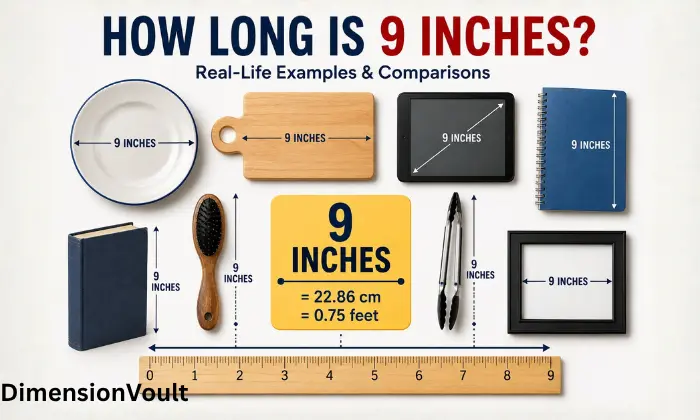
Nine inches is equal to 22.86 centimetres, 228.6 millimetres, 0.75 feet, or 0.2286 metres. It is also exactly three-quarters of a foot, which makes it easier to picture when you think of a standard 12-inch ruler.
In everyday life, this length is roughly comparable to the width of a large dinner plate, the height of some books, or the length of certain small household items. These comparisons can help you understand the measurement without needing to calculate it yourself.
9 Inches Conversion Chart: Inches, Centimetres, and Feet
The table below shows how 9 inches converts into several commonly used units. It provides a quick reference when you need to switch between imperial and metric measurements.
| Unit | Equivalent |
| Inches | 9 inches |
| Centimetres | 22.86 cm |
| Millimetres | 228.6 mm |
| Feet | 0.75 feet |
| Yards | 0.25 yards |
| Metres | 0.2286 metres |
For a simple comparison, 8 inches is 20.32 cm, 9 inches is 22.86 cm, 10 inches is 25.4 cm, and 12 inches is 30.48 cm. This shows that nine inches sits comfortably between eight inches and one foot.
What Does 9 Inches Look Like?
Nine inches is about the length of a spread adult hand for some people, although hand sizes differ from person to person. Another easy reference is a standard 12-inch ruler: the 9-inch point is exactly three inches before the end.
You can also picture this measurement using everyday items. A large plate may be around this size across, while some books, notebooks, and small household objects can have a side close to this length. These examples are only approximate because products and object dimensions can vary.
13 Common Everyday Objects That Are About 9 Inches Long
Comparing a measurement with familiar objects is one of the easiest ways to understand its actual size. The following examples are close to 9 inches, although exact dimensions can vary depending on the product, style, or size.
1. Large Dinner Plate
A large dinner plate is often around 9 inches in diameter, making it a useful visual reference. When you measure straight across the centre from one edge to the other, the distance can be close to this length.
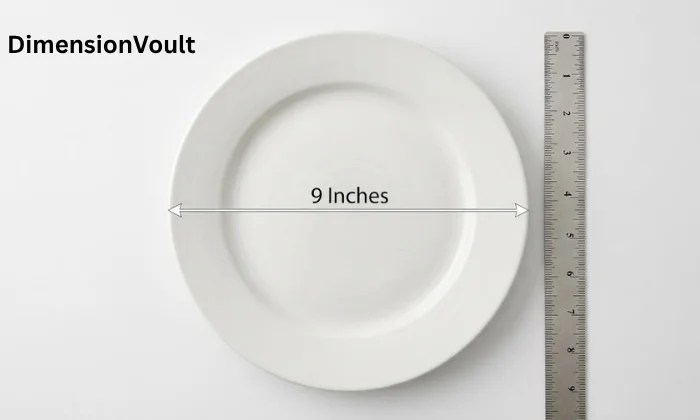
Because plates are common in most homes, they offer an easy way to picture the measurement. Keep in mind that dinner plates come in different sizes, so some may be smaller or larger.
2. Small Tablet or E-Reader
Some compact tablets and e-readers have screens measuring around 9 inches diagonally. This measurement runs from one corner of the display to the opposite corner.
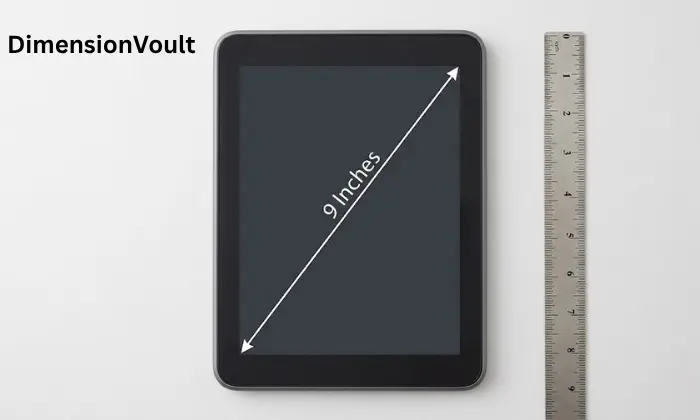
It provides a helpful comparison because the screen is large enough to notice but still much smaller than many laptop displays. The complete device will usually be slightly larger because of its frame.
3. Letter-Sized Paper
A standard US Letter sheet measures 8.5 inches across its shorter side, which is only half an inch less than 9 inches. Placing the paper beside a ruler makes the small difference easy to see.
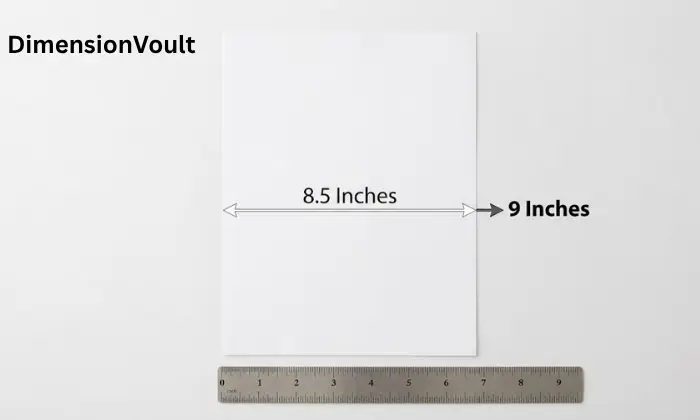
This makes ordinary printer paper a convenient reference. If you imagine adding another half inch to its short side, you would reach 9 inches.
4. Small Cutting Board
A compact kitchen cutting board may measure approximately 9 inches across one side. Smaller boards are often designed for preparing fruit, vegetables, snacks, or other small ingredients.
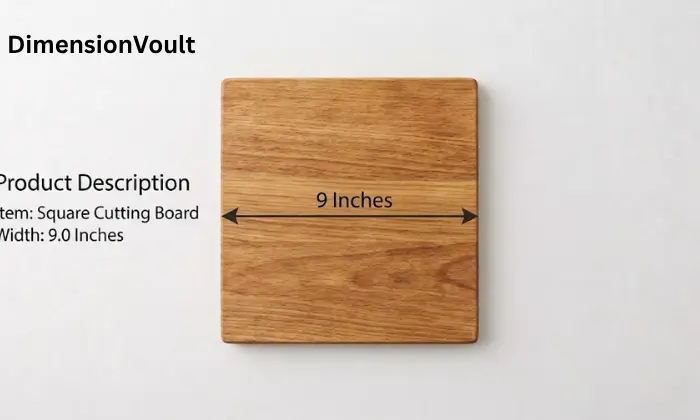
Since the board has a flat surface, its dimensions are easy to visualize. However, cutting boards come in many shapes and sizes, so not every small board will have the same measurements.
5. Kitchen Tongs
Some shorter kitchen tongs are close to 9 inches long from the end of the handle to the tips. Larger tongs used for grilling or cooking may be considerably longer.
A compact pair gives you a practical household comparison. Imagine placing the tongs end to end beside a ruler and they would extend to around the 9-inch mark.
6. Small Frying Pan Handle
The handle of a compact frying pan can sometimes be approximately 9 inches long. The actual length depends on the pan’s design and the manufacturer’s specifications.
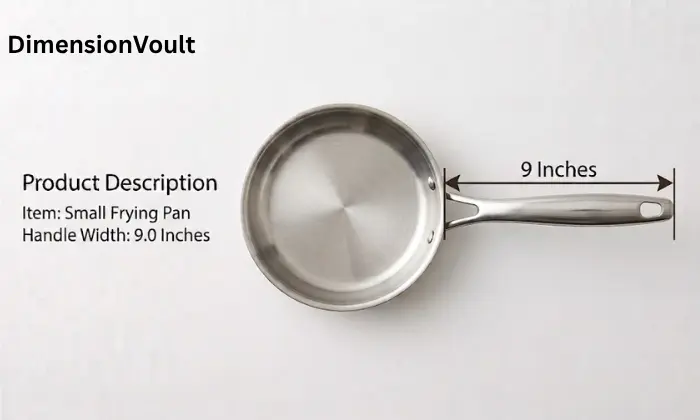
Looking only at the handle helps you visualize the measurement without including the cooking surface. It is a useful example because frying pans are familiar kitchen items.
7. 9-Inch Ruler
A 9-inch ruler is the most direct example because its entire length is exactly 9 inches. It gives you a precise physical reference rather than an estimate.
You can use it to compare the size of other objects around your home. It also shows that the measurement is three inches shorter than a standard 12-inch ruler.
8. Small Picture Frame
Some small picture frames have a width or height of approximately 9 inches. The exact dimensions depend on the frame’s shape and the size of the photograph it is designed to hold.
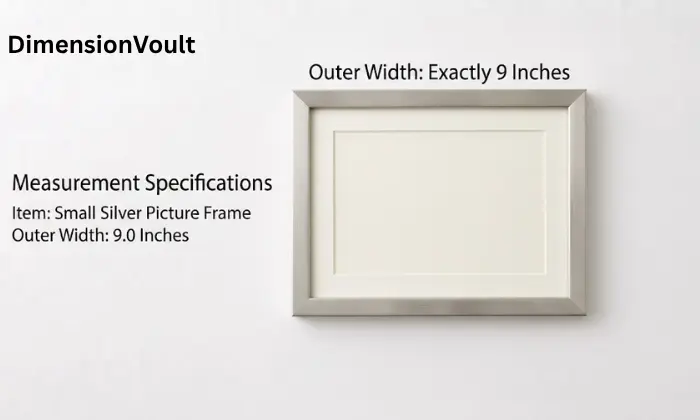
A frame is easy to use as a visual reference because its straight edges make the length clear. If one side measures close to 9 inches, it gives you a good idea of the distance.
9. Hardcover Book
Some medium-sized hardcover books are roughly 9 inches tall. Book dimensions vary widely, but certain novels, reference books, and larger editions can come close to this height.
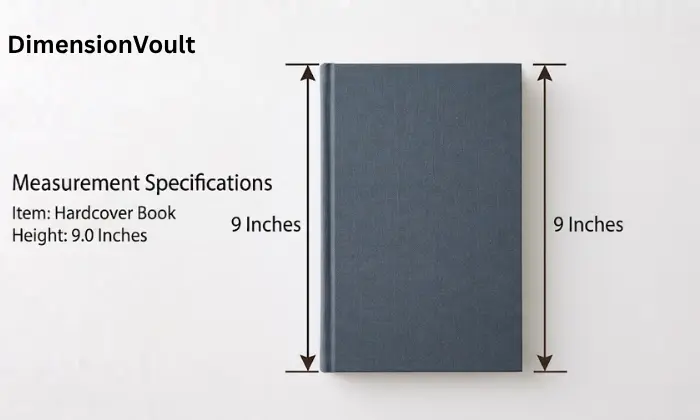
Holding a book next to a measuring tape can make the size easier to understand. A book that stands around 9 inches tall gives you a familiar reference for the measurement.
10. Small Serving Tray
A compact serving tray may have one side measuring close to 9 inches. Smaller trays are commonly used for carrying cups, snacks, desserts, or small dishes.
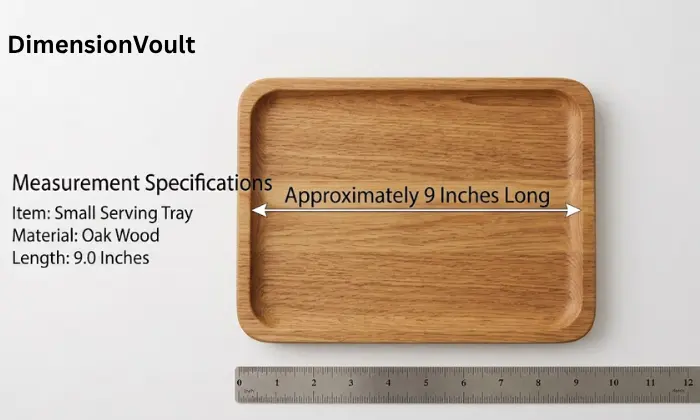
Its flat shape makes the length easy to compare with a ruler. Larger serving trays can be much longer, so this example applies mainly to smaller designs.
11. Compact Keyboard
Some very small or compact keyboards can be around 9 inches wide. These models are designed to take up less desk space than a traditional full-size keyboard.
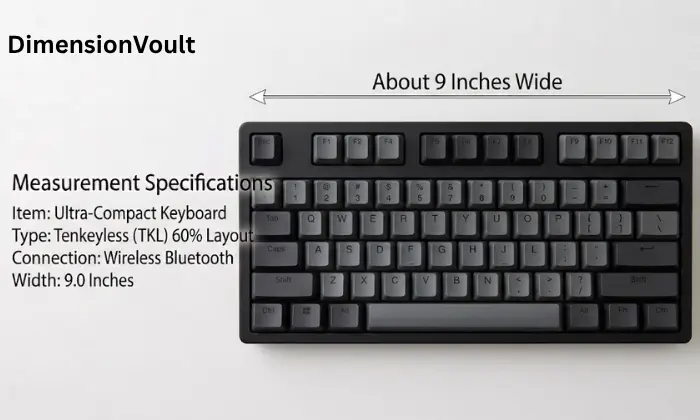
This is a useful comparison because the width is easy to see at a glance. A compact keyboard measuring about 9 inches gives you a good sense of how much space this distance covers.
12. Small Notebook
A small notebook can have a height or width close to 9 inches, depending on its format. Larger notebooks may be noticeably bigger, while pocket-sized versions are much smaller.
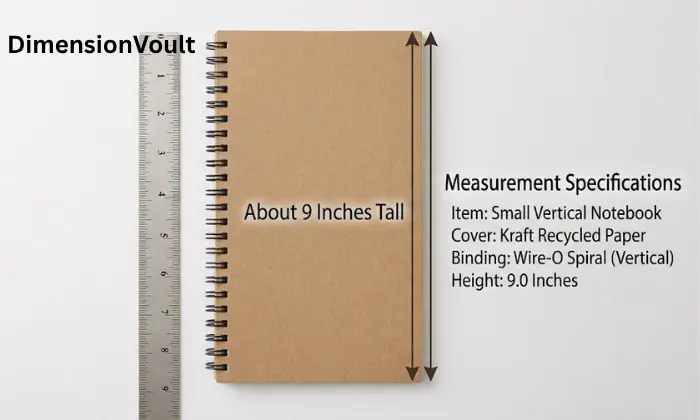
A notebook is a simple object to compare because its straight edges make the dimensions easy to imagine. A side measuring about 9 inches is slightly shorter than the long side of standard letter paper.
13. Hairbrush
Some full-size hairbrushes are approximately 9 inches long from the end of the handle to the opposite edge. Smaller travel brushes can be considerably shorter.
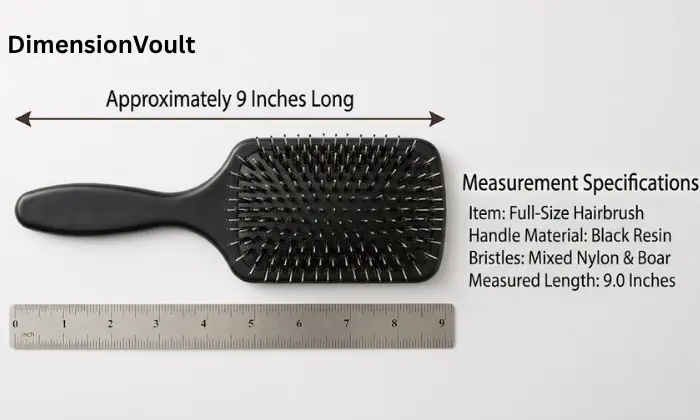
A hairbrush is a useful household reference because its overall length is easy to see and hold. If your brush is close to 9 inches, it can provide a quick visual estimate without using a measuring tool.
How Does 9 Inches Compare to Common Lengths?
Comparing measurements side by side makes it easier to understand how much space 9 inches actually covers. Small differences can be surprisingly noticeable when you place two lengths next to each other.
9 Inches vs 6 Inches: Nine inches is 3 inches longer than 6 inches. In centimetres, 9 inches is 22.86 cm, while 6 inches is 15.24 cm. The difference is large enough to notice easily. If you place a 6-inch object beside a 9-inch object, the longer one extends by another three inches.
9 Inches vs 8 Inches: Nine inches is only 1 inch longer than 8 inches. Eight inches equals 20.32 cm, compared with 22.86 cm for 9 inches. This is a relatively small difference, so the two lengths can look quite similar at first. Placing them side by side makes the extra inch easier to recognize.
9 Inches vs 10 Inches: Nine inches is 1 inch shorter than 10 inches. Ten inches equals 25.4 cm, so the difference between the two measurements is only 2.54 cm. For everyday objects, this small difference may not be obvious without measuring. A 9-inch item and a 10-inch item can look almost identical at a quick glance.
9 Inches vs 12 Inches: Nine inches is 3 inches shorter than 12 inches. Since 12 inches make up one foot, this means 9 inches falls one-quarter of a foot short of a full foot. The difference is easy to visualize with a standard ruler. The 9-inch point is exactly three inches before the 12-inch mark.
9 Inches vs 1 Foot: One foot equals 12 inches, while 9 inches equals 0.75 feet. Therefore, 9 inches is exactly three-quarters of a foot. This is one of the easiest ways to understand the measurement. Imagine dividing a foot into four equal sections; 9 inches represents three of those four sections.
Where Is 9 Inches Commonly Used in Everyday Life?
A measurement of 9 inches can appear in many ordinary situations, from household items to school projects and small DIY tasks. It is not limited to one particular type of measurement.
In the kitchen, it may describe the diameter of a plate, the size of a small cutting board, or the length of certain cooking tools. In crafts and DIY projects, it can be used when cutting materials, marking spaces, or creating small decorations.
You may also encounter this size with school supplies, paper, and notebooks, especially when checking dimensions for projects or storage. At home, some picture frames, trays, shelves, and other small furnishings can have a side close to this length.
In electronics, compact devices and accessories may have dimensions around 9 inches. Clothing and accessories can also use inch measurements for lengths, widths, straps, or other components. Since product sizes vary, the exact measurement should always be checked when precision matters.
How to Measure 9 Inches Without a Ruler
You do not always need a ruler to estimate this length. Several everyday objects and body measurements can help you get close, but remember that body sizes and household items vary. For an exact measurement, a ruler or measuring tape is still the best option.
Use a Standard Letter Paper
If you have US Letter paper, its shorter side is 8.5 inches wide. To get exactly 9 inches, start at one edge of the paper and measure across the 8.5-inch side, then add another 0.5 inch.
In practical terms, place a small object or mark at the paper’s edge, measure the full short side, and then extend the distance by half an inch. The resulting length is exactly 9 inches (22.86 cm).
Use a 12-Inch Ruler as a Reference
If you have access to a standard 12-inch ruler but do not want to use it directly, you can use its markings as a visual reference. Find the 9-inch mark, which is exactly 3 inches before the 12-inch end.
For example, place the ruler beside a piece of string and mark the string at the 9-inch point. You now have a physical 9-inch reference that you can compare with other objects.
Use Three-Quarters of a Foot
One foot contains 12 inches. Divide that distance into four equal parts: each part represents 3 inches. Three of those sections equal 9 inches.
A practical way to estimate this is to imagine a one-foot length and use 75% of it. This gives you 9 inches, although estimating fractions of a foot by eye will not be perfectly precise.
Use a Large Dinner Plate
Many large dinner plates are around 9 inches across, although their exact size varies. To use one as a reference, measure straight across the centre of the plate from one edge to the opposite edge.
If the plate is a 9-inch model, that distance will be exactly 9 inches. If you do not know its size, treat it only as an approximate comparison.
Use Your Hand Span
For some adults, the distance from the tip of the thumb to the tip of the little finger when the hand is fully stretched can be close to 9 inches. However, hand sizes differ significantly, so this should only be considered a rough estimate.
To create your own reference, spread your hand naturally and measure its span once you have access to a ruler or measuring tape. If your span happens to be 9 inches, you can use it as a convenient personal reference later.
Use a 9-Inch Object
If you already have an item that is known to be 9 inches long, you can use it to mark or compare other measurements. For example, a 9-inch ruler, cutting board, or appropriately sized household item can provide a physical reference.
Place the known 9-inch object next to the item you want to measure. If both ends line up, the second object is approximately the same length. This is more reliable than guessing by eye, provided the reference object’s dimensions are known.
FAQs
Conclusion
Nine inches is equal to 22.86 cm or 0.75 feet, making it exactly three-quarters of a foot. A large dinner plate or the shorter side of a sheet of letter paper can help you picture the size, although exact dimensions may vary. Comparing familiar everyday objects with this measurement is a simple way to understand how long 9 inches really is.